Attention Is All You Need: AI Paper
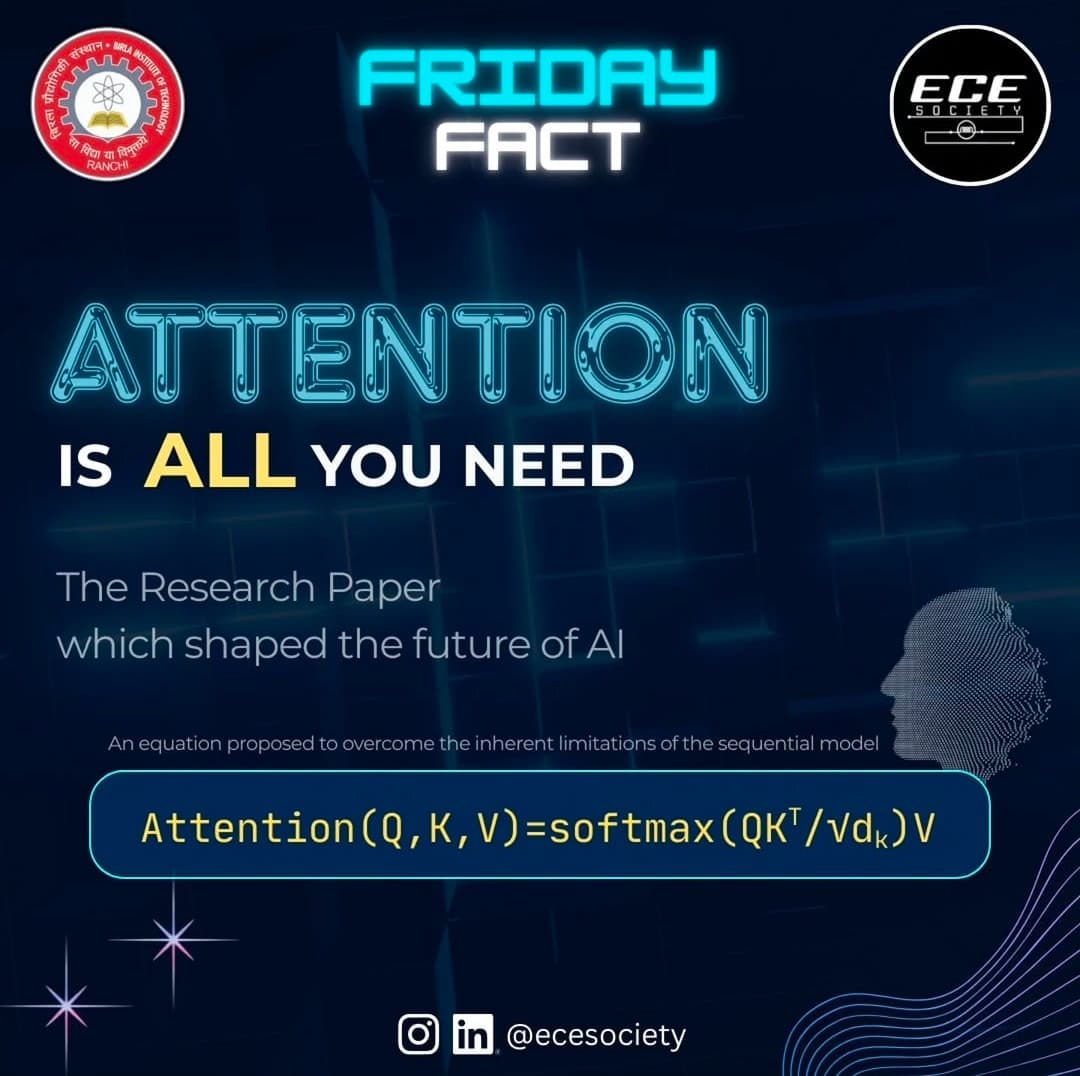
Attention Is All You Need
The Man Behind the Revolution: Ashish Vaswani
Ashish Vaswani, an AI researcher and computer scientist, is best known as one of the lead authors of the 2017 paper "Attention Is All You Need".
Background:
- Education Journey: BTech in CSE from BIT Mesra Ranchi, Jharkhand, India. Master's and PhD in Computer Science from University of Southern California.
- Career Highlights: Staff Research Scientist at Google Brain. Published "Attention Is All You Need" (June 2017).
- Present: Co-Founder & CEO at Essential AI.
His Role in the Paper: He is the co-creator of the Transformer architecture, which completely replaced RNNs and LSTMs with the self-attention mechanism. He led the conceptual design of self-attention, multi-head attention, positional encoding, and the encoder-decoder Transformer structure.
The Real Research Paper
Most research papers provide incremental improvements on existing ideas. But "Attention Is All You Need" (2017) did not extend something—it gave something entirely new.
Ashish Vaswani was the lead author and main architect, alongside critical contributions from Noam Shazeer, Niki Parmar, Jakob Uszkoreit, Llion Jones, Aidan N. Gomez, Lukasz Kaiser, and Illia Polosukhin.
They captured the context of data as well as the relationship between words by introducing the Transformer architecture based entirely on attention mechanisms, ditching RNNs and LSTMs completely. This enabled faster, more effective parallel processing for sequence tasks.
Results: This one paper powered ChatGPT, Claude, and Gemini. With over 175,000+ citations, it revolutionized NLP, computer vision, audio, code, and DNA sequencing, ultimately founding the entire Generative AI industry.
From Noise to Clarity: The Problem & The Ideation
The Old AI (RNNs & LSTMs)
The broken model read ONE word at a time, forgot important context due to the vanishing gradient, processed sequentially (slowly), and could not be parallelized across multiple GPUs.
The Pain Example: Sentence: "The ANIMAL didn't cross the street because it was tired."
- Step 1: "The" -> memory = [0.1]
- Step 2: "animal" -> memory = [0.2, 0.3]
- Step 50: "IT" -> memory = [????????] It forgot what "animal" was!
The Breakthrough Idea
- The Question: Do we need to process words one at a time?
- The Answer: No, We need... ATTENTION.
- The New Approach: Look at all words at once, pay attention only to what's relevant, process in parallel (USE ALL GPUs), and train 10x faster (DAYS, not WEEKS).
Re-Engineering The Model
The Parallel Shift: This research re-engineered AI from a slow "Relay Race" into a parallel system where every word in a sentence is processed at exactly the same time.
The Shortcut Secret: By removing old sequential loops, the Transformer creates a direct shortcut between all words regardless of their distance, allowing the model to see the "big picture".
Built for Speed: The model uses all of a computer's GPU cores simultaneously. In the sentence, "The artist painted the portrait of a woman with a brush", the Transformer doesn't wait to reach the end to understand the word "brush." It sees "brush" and "artist" simultaneously.
6 Layers of Parallel Intelligence
- The 6-Layer Symmetrical Tower: The model is built using a stack of 6 identical Encoder layers and 6 identical Decoder layers.
- The Expert Team: Each layer uses 8 parallel "heads" that act like a team of experts checking grammar and meaning using the Query (Q), Key (K), and Value (V) mathematical engine:
Attention(Q,K,V) = softmax(QK^T / √d_k)V. - Safety and Order: Attention scores are scaled by √d_k to prevent instability, while sinusoidal functions encode positional information.
Where the Signal Goes Next
- The Quadratic Wall: Doubling a sentence's length quadruples required computer power. New research like FlashAttention uses "smart shortcuts" to help AI process entire books without running out of memory.
- Beyond Just Text: Extended to images and videos, achieving state-of-the-art results across domains.
- Instant Responses: New research into Non-Autoregressive Transformers is trying to predict every word in a sentence simultaneously to make AI responses feel truly instant.